


















DeFi Users & Crypto Wallet Holders
Wallet Security, Threat Detection, Asset Protection
Whitepaper
This paper explains the problem we solve, how SenseiGuard and the Guard dashboard work together, and where the product goes next.
SenseiFi is a product of Alphatecks Technologies. It is a Web3 security platform that helps users protect wallets before value is lost. It combines a dashboard with a browser extension that reviews wallet connections and transactions in real time, scores risk, and records activity so users can act with clearer information.
Crypto users lose funds through phishing sites, malicious contracts, unlimited approvals, and signing requests they cannot interpret. Most wallets ask users to approve first and understand later. By then, the damage is often done.
Existing tools are fragmented: scanners without continuous protection, dashboards without interception before you sign, and alerts without a clear path from warning to action.
SenseiFi’s thesis: the differentiator is how accurately you decode and interpret transactions before signing, not the presentation layer alone.
SenseiGuard
SenseiFi Guard
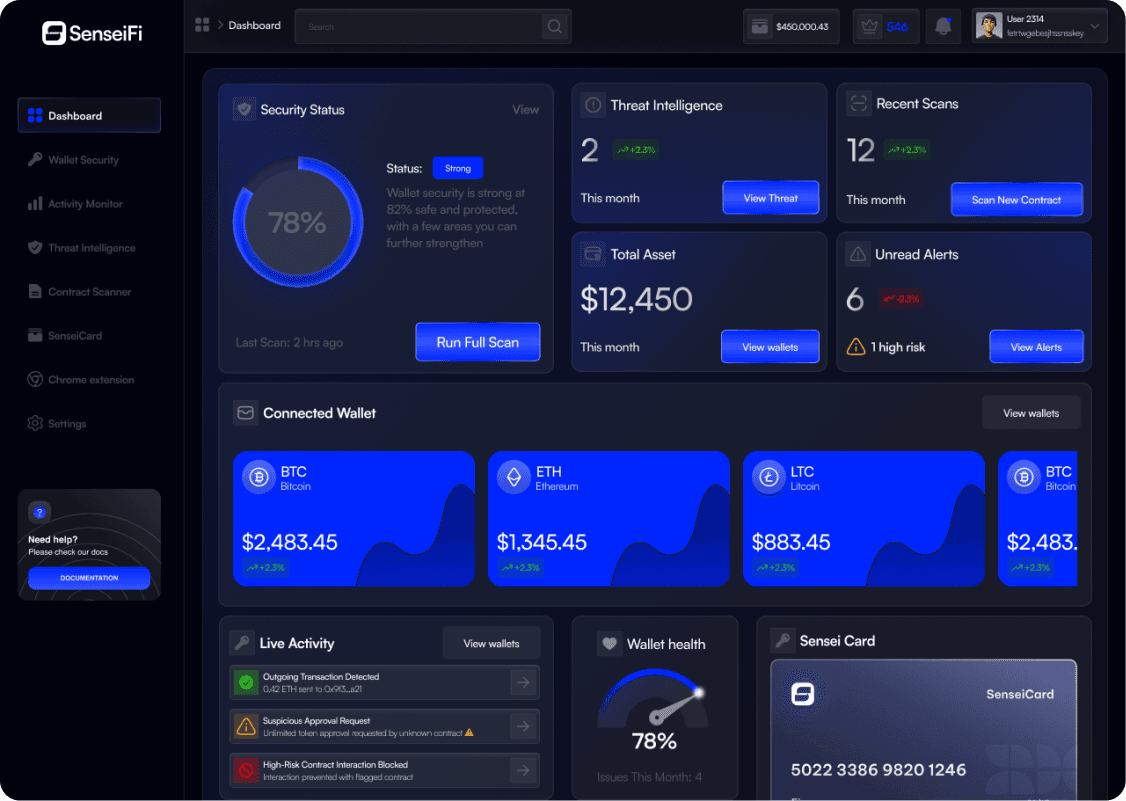
From linking a wallet to recording a connected dApp, SenseiFi keeps the human decision in the loop while removing blind spots around what a request can do.
Link wallet
Sign in on SenseiFi
Extension sync
SenseiGuard adopts session
dApp request
Connect or sign intercepted
Risk check
SenseiFi API scores threat
Decision
Allow, warn, or block
Record
Activity & connected dApps
Analysis runs on the SenseiFi backend so risk logic stays consistent and updatable without shipping a new extension for every detector change.
dApp page
Wallet request
Page hooks
SenseiGuard
Content script
Bridge
Extension UI
Warnings
Background
Risk decision
Guard dashboard
Alerts & dApps
SenseiFi API
Protection engine
Wallet linking today registers Ethereum, BNB Smart Chain, Polygon, Base, and Base Sepolia. The extension also hooks Solana, Cosmos, and Bitcoin providers, with local heuristics only. Any other chain is a plan, not current support. Mobile apps are covered by the privacy policy and are outside this architecture.
In scope: phishing and lookalike domains, contracts and domains on the threat feed, unlimited approvals, setApprovalForAll, transferFrom, eth_sign and typed-data signatures including permit-style v4 payloads, and wallet connections on the hooked providers.
Out of scope in this build: front-running and sandwich attacks, a leaked seed or a compromised wallet, address poisoning of past recipients, bridge and governance attacks that look like ordinary calls, and simulation of Solana, Cosmos, or Bitcoin transactions.
SenseiFi is a product of Alphatecks Technologies. Founders, a leadership roster, and a jurisdiction of incorporation are not published here. Advisors are not published, so none are described as having control. The site is senseifi.io. Support is support@senseifi.io. The privacy policy lists privacy@senseifi.com for data requests. Both addresses are in print today. Community chat is on Telegram at t.me/senseifinance.
Risk policy lives in extension settings and in the API score. Users can turn protection off, proceed past a warning, disconnect, or request deletion of personal data. There is no published external board. SenseiCard’s issuer, processor, and license are unpublished.
SenseiFi is not financial, legal, or investment advice. Roadmap dates are current plans, subject to change. The in-product terms limit liability for indirect and consequential loss, which includes a missed drain and a blocked legitimate transaction. SenseiFi never holds keys and never moves funds.
Default prices in the client are Basic $15 per month, Pro $30, Pro+ $60, and Premium $200, with annual totals of $150, $300, $600, and $2,000. A free tier is listed with one wallet and lower quotas. The API can replace the displayed prices. Subscriptions are the funding model. A split between engineering cost and detection-data cost is not published.
No SenseiFi token exists in this product, and this version does not plan one. No supply or utility is specified.
Quarters below are intentions as of 11 October 2026. They can change.
The homepage currently shows $278B, <1s, and 300+ signals. None of those strings has a methodology or an as-of date, so this paper does not treat them as measured results. The current source does not contain $409B, 442+, $-409B, or <-1s. The counter animates upward from zero and does not introduce a minus sign.
Users sign a message to authenticate. SenseiFi does not hold keys or move funds. SenseiGuard sits in front of the wallet prompt. It does not replace the wallet.
Transaction context and telemetry can be used to train detection models, as the privacy policy states. That processing is separate from key handling. Dashboard data is scoped to the signed-in user. Insights stay advisory.
Fewer signatures the user did not understand. A visible list of connected dApps. A documented result when the API is down or wrong. Published accuracy, once it is measured.
SenseiFi exists to put security intelligence in front of the signature, and a durable record behind it. Review before you sign through SenseiGuard, and visibility after you connect through the Guard dashboard, form the product’s core loop.
SenseiFi Whitepaper, Version 1.3, 11 October 2026. Plans in the roadmap are subject to change.



 2 connected wallets
 $12.50 USDC